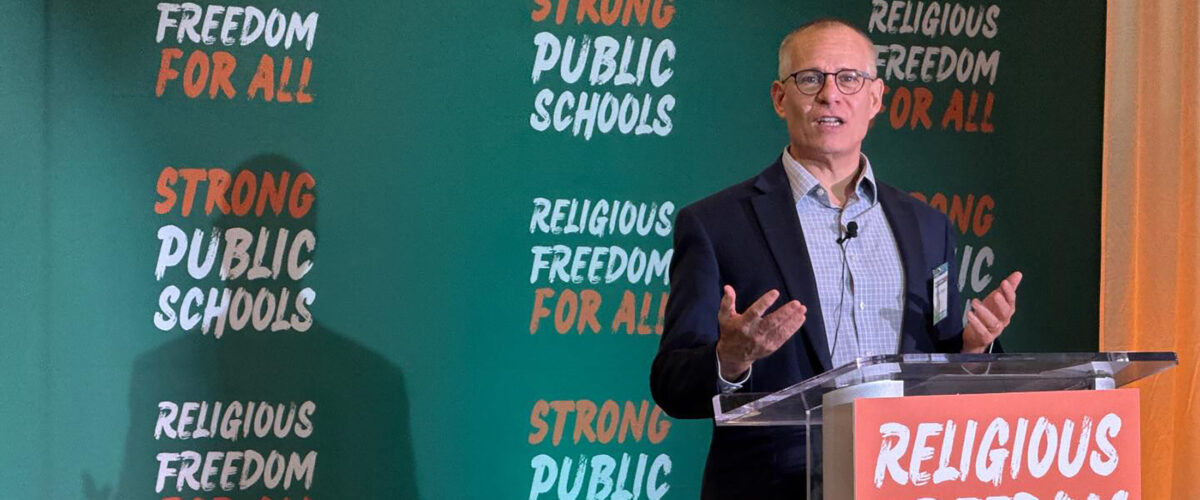
The Bible has not been banned from public schools, but there are appropriate and inappropriate ways to use it there, a professor told a summit on religion and public education Sept. 16.
Mark Chancey, professor of religious studies at Southern Methodist University, was one of 15 speakers at the two-day summit in Dallas sponsored by Interfaith Alliance and 20 cosponsors. His assigned topic was “The Use and Abuse of the Bible in Public Schools.”
Contrary to what some evangelicals contend, the Bible has not been banned from public schools, he explained, outlining differences between teaching about the Bible versus teaching the Bible as religious dogma.
“The starting point for this topic is the 1963 U.S. Supreme Court decision Abington Township School District v. Schempp. This decision prohibited ritualized devotional school-sponsored, school-led Bible reading. By this I mean reading the Bible every day in homeroom or reading the Bible at opening assembly or reading the Bible over the PA system, for example,” he said.
While that ruling expressly forbade “government-sponsored religious exercises that violated the First Amendment,” it also explicitly affirmed “the academic study of the Bible and other aspects of religion when done for the sake of cultural literacy.”
The majority opinion was written by Justice Thomas “Tom” Clark, who was from Dallas, and was an active Presbyterian layman, Chancey noted. He is buried 7 miles away from where the conference was held.
In that decision, Clark wrote, “It might well be said that one’s education is not complete without a study of comparative religion or the history of religion and its relationship to the advancement of civilization. It certainly may be said that the Bible is worthy of study for its literary and historic qualities. Nothing we have said here indicates that such study of the Bible or of religion, when presented objectively as part of a secular program of education, may not be effected consistently with the First Amendment.”
Yet what was at stake in the court ruling was not such a practice, he continued. “The exercises here do not fall into those categories. They are religious exercises, required by the states in violation of the command of the First Amendment that the government maintain strict neutrality, neither aiding nor opposing religion.”
Chancey said lower courts have since offered more guidance on this distinction: “Some of that guidance is obvious. Teachers can’t proselytize, teachers can’t try to convert students to a religious perspective. Also, schools are not supposed to present Bible stories as straightforward history or scientific description, particularly stories of supernatural action or divine intervention. Broadly speaking, instruction should not promote particular religious perspectives or religion in general or non-religion in general.”
In practice, the Bible is most likely to show up in social studies classes, world history courses or U.S. history and government courses or English language arts, he said. But Bible references also are likely to show up in music classes or choral classes.
“All these contexts provide opportunities for the type of valid academic treatment that Shempp prescribes. But all of these contexts also provide ample opportunities for viable misuse to promote one particular thing.”
For example, efforts in Oklahoma and Texas to infuse social studies standards with Bible stories violate this principle, he said. “A 2009 study by Texas Dream Network on sex education classes found religious content in almost 10% of the districts that were studied. One school’s handout on how to pick a prospective mate said a student should ask, ‘Is Jesus their first love?’”
Under current law, public schools are allowed to offer courses that teach the Bible as literature, Chancey said. But those courses may not privilege the Bible and Christianity as superior to other religious beliefs.
Another thing that’s legal in several states is release time for religious studies.
“Release time is often controversial, but it’s been around for a long time,” Chancey explained. “Release time credit is kind of a renewed push and that is to give academic credit for religious instruction taken off campus during the school day.”
The Kentucky Legislature, for example, recently passed a release time provision. Such practices have been common Mormon-majority communities for years.
Current efforts in some states to require posting of the Ten Commandments in every public school classroom are another example of religious indoctrination that previously was ruled unconstitutional by the Supreme Court.
There is a Texas-specific angle to this story, Chancey said. “We have a widespread campaign to display not only the Ten Commandments in general, but the specific version that is found on that monument down in Austin.”
He showed a map of legislation related to the Ten Commandments that showed three states that have passed laws and 14 other states where bills have been introduced to post the same altered King James Version of the commandments.
The Texas legislation, which previously failed before it passed this year, has been copied in other states.
Original Article – Prof reviews proper and improper uses of Bible in public schools – Baptist News Global