Utah students will be required to analyze specific Bible passages referenced or “alluded to” in U.S. historical documents as part of the state’s sweeping new social studies curriculum. That’s under HB312 “School Curriculum and Standards Modifications,” which Gov. Spencer Cox signed into law last week.
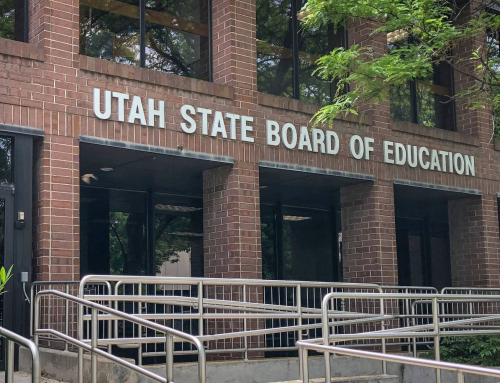
Exactly which passages would need to be studied has yet to be determined, but the Utah State Board of Education has until the 2028-29 school year to decide. The measure directs public schools to incorporate the Bible as a historical and literary text that influenced early American thought into core social studies instructions. It also requires a comparative analysis of certain “philosophical traditions,” including “Enlightenment philosophy, Protestant and Catholic thought, deism and natural law theory.” Students in grades three through 12 are subject to the standards.
That all means educators will be teaching pieces of the Bible but not the “Bible as a whole,” said Jennifer Wadsworth, a policy advisor with USBE.
“It’s just the specific passages from the texts that allude to founding documents,” Wadsworth said. She added the bill explicitly prohibits teaching “theology or doctrine,” and that religious concepts must be discussed in a “historical context” that have a “documented influence on American civic thought.”
That includes references to “Nature’s God,” “Creator,” “Supreme Judge of the world” and “divine Providence” in the Declaration of Independence, according to the bill’s language. It allows for other religious concepts that appear in historical documents to be explored, too, though that wouldn’t be required.
The bill’s sponsor, Rep. Tiara Auxier, R-Morgan, said it gives the state the power to create its own civics education rooted in Utah values.
“If we want control on what our students are being able to learn and being taught, we want to not have to be getting our textbooks from California,” Auxier said at a March 5 House hearing on the bill.
Developing that curriculum will cost taxpayers roughly $12 million, according to the bill’s fiscal note.
Auxier did not respond The Salt Lake Tribune’s requests for comment.
Before signing the bill, Cox previously told The Tribune he feels confident it falls within the First Amendment’s guardrails.
“I would encourage people to actually look at what the bill is and what it does,” Cox said. “It’s not [the] Bible for spiritual study. It’s about understanding history and the things that influence people. And I think it would be irresponsible not to have those types of great books being understood when it comes to a civics curriculum.”
Bill may be first of its kind, one expert says
The curriculum change may be the first of its kind, said Patrick Elliott, legal director for the Freedom From Religion Foundation. The organization advocates for the separation of church and state.
“I don’t know that other states have done this through a state statute and in this very detailed manner,” Elliott said.
States like Oklahoma have passed legislation allowing students to partake in optional Bible-based courses. And district-level programs, such as in Hamilton County School District in Tennessee, have long offered elective courses examining the Bible through an academic lens. In 1963, the Supreme Court ruled that while public schools cannot sponsor Bible readings and recitations of the Lord’s Prayer, the Bible may be taught as a “historical” and “literary” text.
“The Bible is worthy of study for its literary and historic qualities,” the ruling states. “Nothing we have said here indicates that such study of the Bible or of religion, when presented objectively as part of a secular program of education, may not be effected consistently with the First Amendment.”
Clifford Rosky, a law professor at the University of Utah, said HB312 doesn’t violate the First Amendment — at least not on paper.
“It’s very clear that the bill was carefully drafted by people who are aware of the Supreme Court precedents in this area,” Rosky said. “[It’s] written to maximize the amount of teaching about religion, while not requiring or permitting the teaching of religion.” In practice, though, the bill could infringe on students’ and teachers’ constitutional rights, he said. “They’re now asking Utah public school teachers to stand up in front of their class — even third graders — and say: ‘This is what the Bible says, and here are all the different things that people think it means,’” Rosky said. “I would think that that’s going to create a lot of division in the community.”
Rosky noted that it’s “unusual” to require regular social studies instruction in elementary grades, as many of the concepts are relatively advanced. “It’s old language, 200-year-old language,” he said, referring to U.S. founding documents. “Little kids have trouble understanding it.”
The bill directs the state board to develop “age-appropriate” social studies curriculum for younger grades, while also adhering to the specific requirements.
Utah law does allow students and parents to “refrain from participation in any aspect of school that violates a religious belief or right of conscience.”
Should students opt out, though, it’s currently unclear how they would alternatively earn their required social studies credit. The bill’s sponsors did not respond to The Tribune’s questions.
‘What the founders said you should not support’
Christian nationalism has become increasingly popular in GOP-led states, according to recent findings from the nonpartisan Public Religion Research Institute, Axios reported in February. The ideology asserts the U.S. was founded as a Christian nation and should be governed with Christian values.
Eric Hinderaker, a distinguished professor of history at The U., said he views HB312 as an attempt by Utah lawmakers to prop up that ideology.
“There’s a lot of misunderstanding about the place of religion in public life in the era of the American Revolution,” Hinderaker said. “These people were coming out of a context where state-supported religion was the norm. Where, in other words, governments and religions were closely integrated with each other. They saw that as a huge problem.”
The Founding Fathers valued religious freedom, he continued, which they defined as allowing people to “form their own judgments about the creation of the universe and about the place of God in their lives.”
He argued that while documents like the Constitution and Declaration of Independence contain religious concepts, they aren’t inherently biblical.
“It is misleading to suggest that the Bible is an especially important text in influencing American constitutional history,” Hinderaker said, adding that the Founding Fathers intentionally chose not to make any references to the Bible.
Bills like HB312 were what our Founding Fathers were hoping to avoid in writing the First Amendment, Hinderaker argued.
“I think increasingly the fear is being propagated in our society that Christianity is collapsing,” he said. “And so this is an attempt by lawmakers to use the power of the state to prop it up. That is exactly what a religious establishment is. And that is exactly what the founders said you should not support.”
Original Article – Utah students will need to learn Bible passages in American history lessons